Kitchen Island Ideas for Liverpool Homes: What Works in a Standard Semi-Detached
Kitchen islands have become one of the most requested features in Liverpool kitchen renovations, and also one of the most frequently disappointed projects - not because islands are a bad idea, but because the space requirements are more demanding than most people realise when they're looking at design inspiration online. A kitchen that looks like it has room for an island often doesn't, once you account for the clearance needed to open appliances, walk around the island comfortably, and still have functional work triangles between the hob, sink, and fridge. Getting this assessment right before you've committed to a layout saves a significant amount of cost and frustration.

The Space Requirement Reality
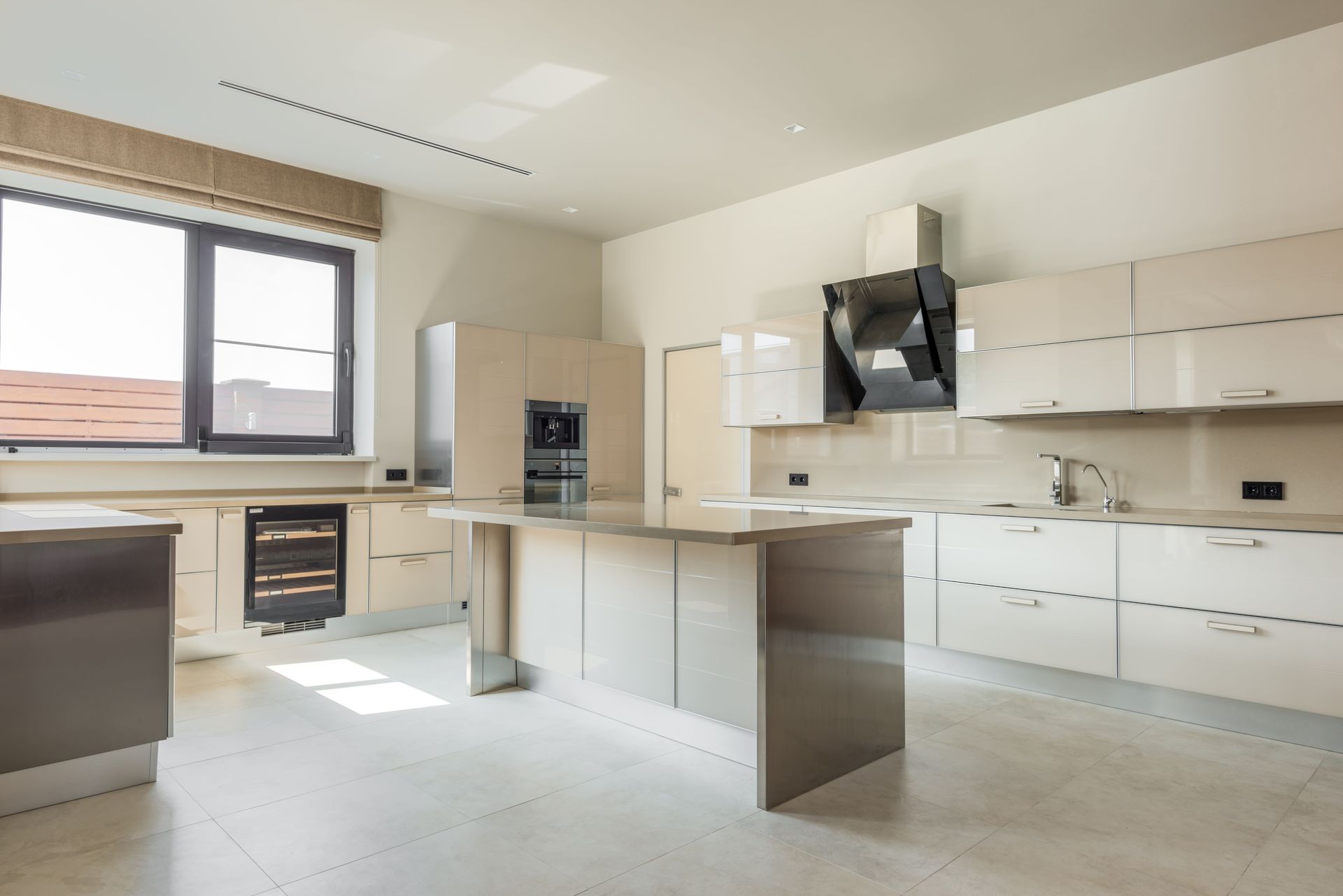
The minimum recommended clearance around an island is 900mm - the width needed for a person to work comfortably and for appliance doors to open without obstruction. That means an island 900mm wide needs at least 900mm of clearance on each side that faces a kitchen unit or appliance, plus clearance at each end. In practical terms, for a freestanding island with all-round access, you need a kitchen footprint of roughly 4 metres by 3 metres as an absolute minimum.
Most Liverpool semis and terraces in areas like Wavertree, West Derby, and Childwall have kitchen footprints of 3.5 to 4 metres wide. This means a true freestanding island - with clearance on all four sides - is often marginal or impossible. A peninsula layout (an island fixed at one end to a wall or run of units) uses the same principle but only needs clearance on three sides, which works in a significantly smaller kitchen.
Island vs Peninsula: Which Suits Liverpool Kitchens
Kitchen Fitters Liverpool fits both islands and peninsula extensions, and for most standard Liverpool semi-detached kitchens the peninsula is the more practical solution. It delivers most of the benefits of an island - extra worktop area, seating on one side, a visual centrepiece to the room - without the space requirement of all-round clearance. For Liverpool kitchens that open into a dining area via knocked-through walls (increasingly common in renovation projects across the city), a peninsula that faces into the open-plan space can also serve as a breakfast bar, which is what most clients actually want from an island.
A true freestanding island works best in larger Liverpool properties - detached houses with proper open-plan kitchen-diners, extensions where the kitchen footprint has been substantially increased, or through-wall knockthroughs that have created a genuinely large kitchen space.
Seating at the Island
If seating is part of the plan - a breakfast bar overhang for stools - allow for the overhang dimension in your clearance calculations. A 300mm overhang on the seating side is the practical minimum for knee room; 400mm is more comfortable. This adds to the island's effective footprint from the seating side.
Services: The Practical Complication
We've covered kitchen worktop choices for Liverpool homes elsewhere, but the service question is one of the practical challenges specific to islands. If you want a sink or a hob in the island, drainage and gas or electrical supplies need to reach a mid-floor position, which means either running services under the floor (more complex, more cost) or boxing them in above the floor in a way that doesn't create a trip hazard. An island with neither sink nor hob is straightforward to install; one with services requires more planning.
What a Kitchen Island Costs in Liverpool
Basic island unit (purchased, fitted by kitchen installer, no services): £800-£2,500 depending on the unit size and specification.
Peninsula extension from existing run of units (custom or semi-custom, no services): £1,500-£3,500.
Island with sink or hob, including services: Add £500-£1,500 for the additional plumbing or electrical work depending on how accessible the sub-floor is.
FAQ
Q: What's the minimum kitchen size for an island in a Liverpool home?
A freestanding island with all-round clearance needs approximately 4m x 3m as a minimum footprint. A peninsula (fixed at one end) works in a smaller space. Most standard Liverpool semis are on the margin for a true freestanding island.
Q: What's the difference between an island and a peninsula?
An island is freestanding with clearance on all four sides. A peninsula is attached at one end to a wall or run of units, so only needs clearance on three sides. A peninsula suits smaller kitchens and delivers most of the practical and visual benefits of an island.
Q: Does a kitchen island need plumbing or electrics in Liverpool?
Only if you want a sink or hob in it. An island used purely for food preparation, storage, and seating needs no services at all. Adding a sink or hob requires running new services under the floor, which adds cost and complexity.
Q: Can a kitchen island be added to an existing Liverpool kitchen without a full renovation?
A freestanding island unit can be added to an existing kitchen if the space is adequate - it's essentially a piece of furniture at its simplest. A peninsula extension or a fully integrated island with services requires more work and is usually done as part of a wider kitchen project.
You might also like
Kitchen Fitters Liverpool